

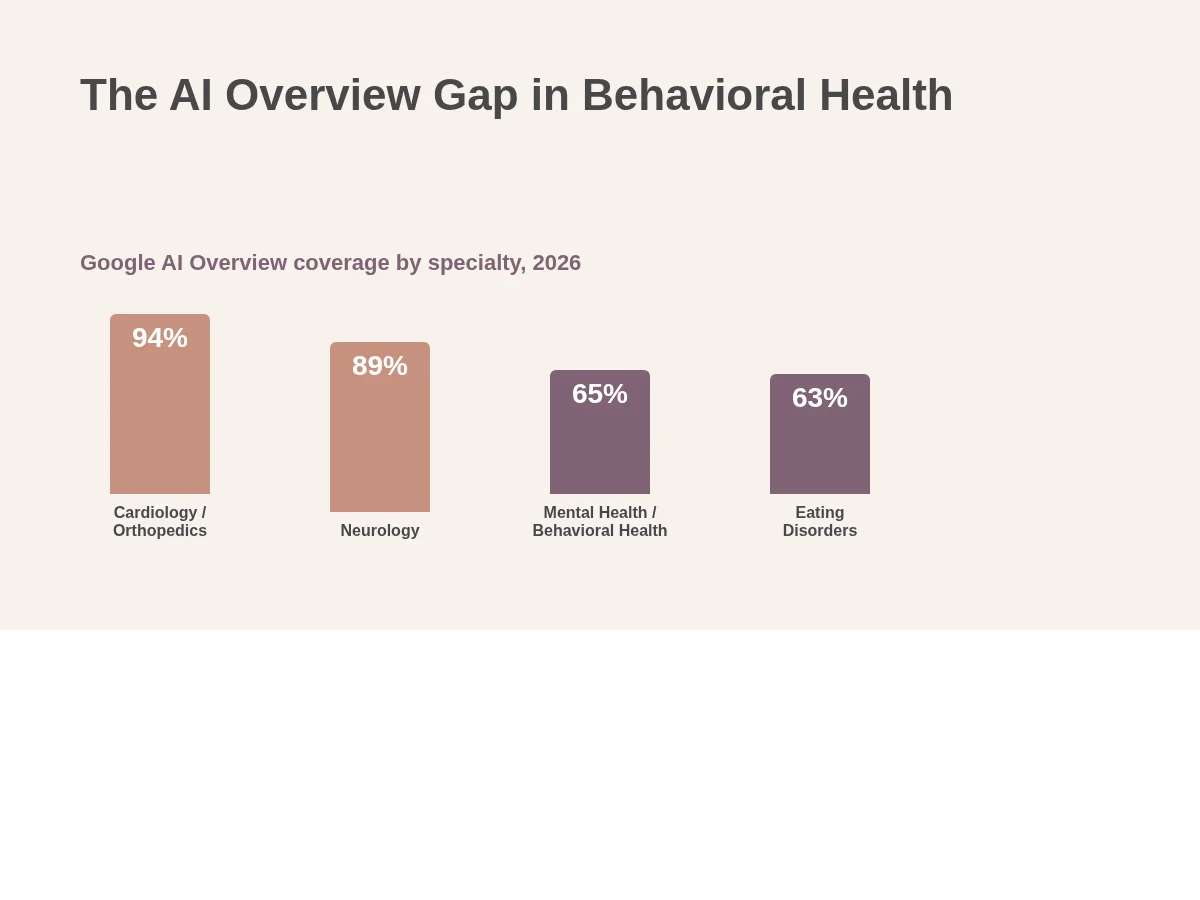
An analysis of over 130,000 health related searches published July 28, 2026 found that Google’s AI Overviews now appear in 51% of all healthcare searches, more than double the rate in any other industry. But that average hides the number that matters for treatment centers: mental health and behavioral health content shows an AI Overview only 65% of the time, and eating disorder content only 63%, versus 94% to 97% for specialties like cardiology, urology, and orthopedics. Google has said it deliberately keeps certain sensitive topics, including addiction and mental health crisis content, out of AI-generated summaries in some contexts.
That is not a small gap. It is a structural difference in how the two most common starting points for finding care, a Google search and a query typed into ChatGPT or Perplexity, treat your category compared to nearly every other kind of provider on the internet.
This matters for admissions teams in Naples, Florida, Minneapolis, Minnesota, and every other market where a family is searching for a program at 2am, because the AI layer that now answers most other health questions on their behalf is largely staying out of the conversation for behavioral health and addiction. That means the traditional search result, the actual page a family clicks, still decides more of the outcome in this category than it does almost anywhere else in healthcare.
What the 65% number actually means
Google’s AI Overview coverage by clinical specialty, from the same July 2026 analysis:
| Specialty | AI Overview coverage |
|---|---|
| Genetic and genomic content | 97% |
| Cardiology | 96% |
| Urology | 96% |
| Gastroenterology | 94% |
| Orthopedics | 94% |
| Neurology | 89% |
| Mental health / behavioral health | 65% |
| Eating disorders | 63% |
The roughly 30 point gap between core clinical specialties and behavioral health is not random. Google treats mental health and addiction as topics where a single AI-generated summary is riskier to publish, more contested, and more likely to need individualized guidance rather than a generic answer. Practically, that keeps the traditional organic result, the one your website either wins or loses, in front of the searcher far more often in this category than in almost any other kind of healthcare search.
The two things this changes about a treatment center’s marketing
1. Traditional SEO still decides the click, more than it does for most healthcare
If a cardiology practice loses the AI Overview, the visit was largely already lost, since the summary answered the question before the click happened. A treatment center rarely gets that AI Overview competing for the click in the first place. That means the actual ranking position, the actual page title, and the actual page content still do the job of winning the family’s attention in behavioral health, in a way that has quietly stopped being true for a lot of other specialties this year.
2. Where AI answers do appear, the citation sources are thin
Separate analysis of AI Overview health citations found that roughly two thirds come from sources without strong medical or evidence based safeguards, with YouTube cited more often than hospitals, clinics, or professional associations. When a family does get an AI-generated answer about a program type, a level of care, or a treatment approach, there is a real chance the source behind that answer is a video, not a licensed provider’s own page. A treatment center’s own admissions and levels of care pages, built with real clinical detail and structured so an AI system can extract it cleanly, are exactly the kind of source this creates room for. The opportunity is not to fight for the AI Overview slot. It is to be the structured, citable source when one eventually appears. This is the same structured-data work BSPKN’s own SEO process builds for every client site, not a separate add-on service.
What to check on your own site this week
- Do your levels of care pages answer the specific question a family is asking (what is IOP, what is the difference between inpatient and outpatient, what does verification of benefits mean) in the first two sentences, not after three paragraphs of program philosophy?
- Is there a named, credentialed person attached to your clinical content, or is every page written in an anonymous institutional voice?
- Does your admissions page load fast and read clearly on a phone, since the traditional result is doing more of the work here than in other specialties?
- Are your service area cities actually named on the page, not just in a footer, so local intent searches still find you where the AI layer has not taken over the SERP?
A free Peek AI visibility scan shows exactly how your program shows up, or does not, right now when someone asks an AI assistant for a provider like yours, and where the citation sources currently pulling that answer are coming from.
FAQ
Why do fewer mental health searches show a Google AI Overview than other health topics?
Google has stated it deliberately limits AI-generated summaries for sensitive topics including addiction and mental health crisis content, where a single generalized answer carries more risk than in a topic with a clear, well documented diagnostic pathway.
Does that mean treatment centers do not need to worry about AI search?
No. It means the traditional search result still carries more of the weight for now, so on-page SEO, page speed, and local relevance still decide more outcomes in behavioral health than they do in specialties where the AI Overview has largely taken over the click.
Where are AI systems getting their information when they do answer addiction or mental health questions?
Independent analysis of AI Overview health citations found roughly two thirds come from sources without strong medical or evidence-based safeguards, with YouTube cited more often than hospitals or clinics, which is a real opening for a treatment center’s own clinical content to become the cited source instead.
How can a treatment center find out how it currently shows up in AI search?
Run a free Peek AI visibility scan, which checks how your program appears across AI assistants and search right now and flags the specific gaps behind it.
How this plays out for a real client: Naples Retreat, a residential recovery program in Naples, Florida, competes in one of the more expensive behavioral health CPL markets in the country. Because a family searching for care there is far less likely to be handed an AI-generated answer than a family searching for a cardiologist, the traditional page, the one actually optimized for the real question a family is asking, has continued to carry the campaign. Naples Retreat’s Meta campaigns brought in 633 patient inquiries at a $14.42 CPL in that market, work described here to show what this category’s search behavior actually rewards, not a projection for every program. See more of that work on our success stories page.
The AI layer is going to keep expanding into more of healthcare. It is expanding into behavioral health more slowly than anywhere else, on purpose. That is a real, if temporary, advantage for programs that use the time to fix their own pages instead of waiting on a search engine that has already decided to stay out of the conversation. GEO strategy and healthcare marketing built around this gap does the work while it still matters most. Book a 15 minute strategy call to walk through what your own pages are missing.


