

PELORA Marketing read the public pages of 30 treatment center websites on October 24, 2026, pulled from SAMHSA’s FindTreatment.gov locator across 10 metro areas: Seattle, Phoenix, Denver, Dallas, Kansas City, Minneapolis, Nashville, Atlanta, Columbus and Boston. Only 16 of the 30 homepages showed the phone number the federal locator lists for that center. The other 14 showed a different number, with no way for a caller, or an AI engine, to know which one is current.
Run your own center through a free AI visibility scan and see exactly what ChatGPT, Perplexity and Google’s AI features can find on your site right now, before you read the rest of this.
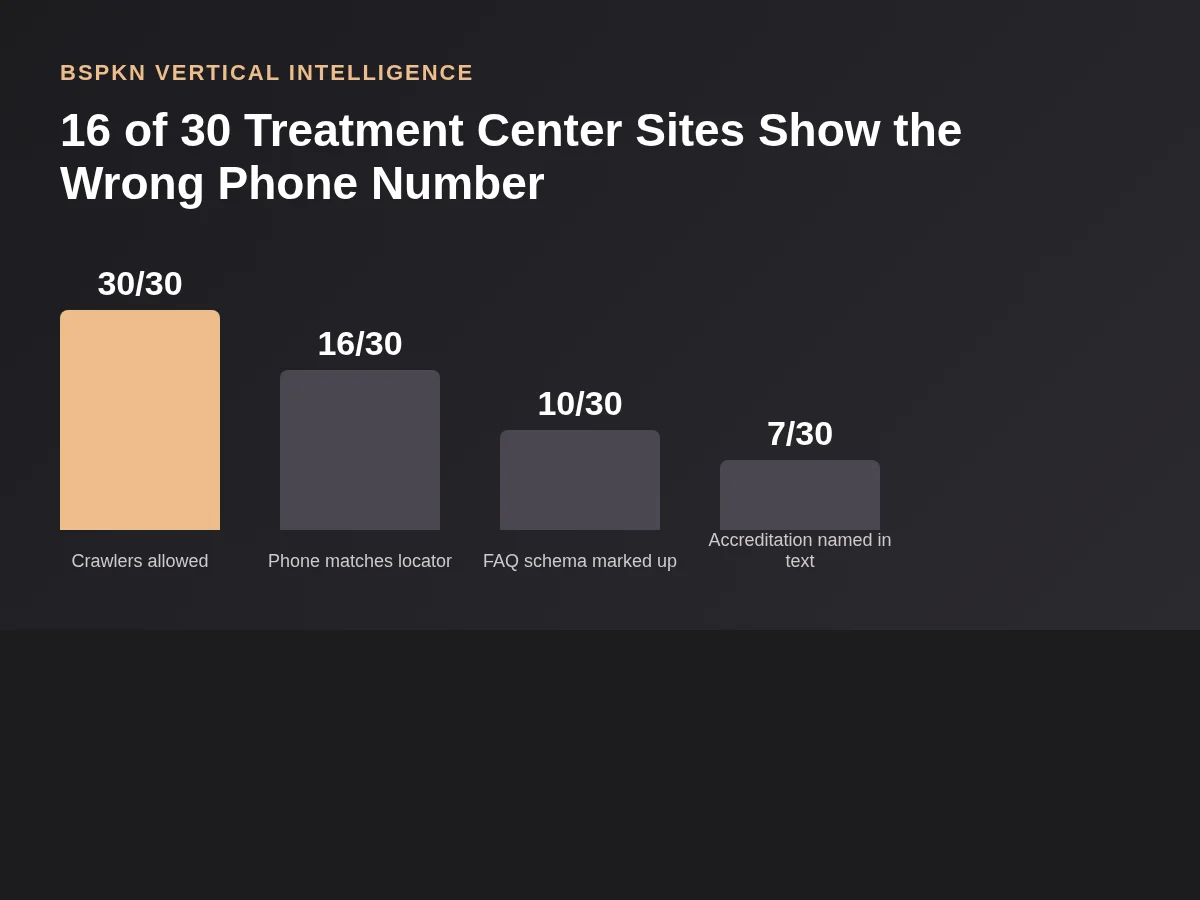
What the audit actually checked
This was not a test of what ChatGPT or Perplexity says about any center. PELORA queried no AI engine at all. It read 30 public homepages, their robots.txt files, and one linked FAQ page and blog article each, looking for the plain signals a language model can use to answer a question: can it reach the page, does the page say who the center is, where it is, how to call it, and which questions it already answers.
| Signal checked | Sites that passed (of 30) |
|---|---|
| robots.txt allows AI search crawlers | 30 of 30 |
| Main text readable without running scripts | 30 of 30 |
| Business schema naming the organization | 25 of 30 |
| Phone number matches the SAMHSA locator | 16 of 30 |
| FAQ section shown on the site | 14 of 30 |
| Phone number also present in schema | 12 of 30 |
| Accreditation (Joint Commission or CARF) named in visible text | 7 of 30 |
| FAQ marked up with FAQPage schema | 10 of 30 |
Crawler access was never the problem. Every site in the sample let Googlebot, Bingbot, OAI-SearchBot, Claude-SearchBot and PerplexityBot read the homepage, and not one robots.txt file blocked a search crawler. The median site passed 7 of 10 checks. Two of 30 passed all 10. Seven of 30 passed 5 or fewer, which is where a center stops being readable and starts being guessed about.
The phone number problem is bigger than SEO
A model answering “does this center take my insurance” or “what number do I call” pulls from whatever text it can read fastest. When the homepage shows one number and SAMHSA’s locator shows another, a model has no way to know which one is current, and neither does a parent searching at 11pm. 22 of 30 homepages in the audit showed a phone number and a full address, which is the baseline. Only 12 of 30 put that phone number inside structured data (schema markup) that an AI system reads directly rather than inferring from a page layout.
The fix costs nothing: one sentence stating the number that matches the locator and the Google Business Profile, repeated in the page’s schema, not just its visible text.
Accreditation is named in text on fewer than a quarter of sites
11 of 30 centers referenced LegitScript certification somewhere in their code, most often as an image seal rather than a sentence. Only 7 of 30 named The Joint Commission or CARF accreditation anywhere in visible text. An image seal does not get read the same way a sentence does. If a center holds a real accreditation, saying so in a plain sentence, not only in a badge graphic, is the difference between a model being able to cite it and a model having nothing to cite.
FAQ content exists, the markup mostly does not
14 of 30 homepages linked an FAQ page, which means the content a model needs to answer specific questions, like cost, length of stay, or what insurance is accepted, already exists on more than a third of these sites. But only 10 of 30 marked that FAQ up with FAQPage schema, the structured label that makes a question-answer pair easy for a crawler to lift cleanly. Of the 14 sites with an FAQ, 6 never added the markup. The content was already written. Nobody told the machine it was there.
What a treatment center should fix first
- Match the phone number everywhere. Homepage, SAMHSA locator, Google Business Profile, and schema markup should all show the same number.
- Mark up the FAQ you already have. Adding FAQPage schema to existing questions is a markup change, not a rewrite.
- Name accreditation in a sentence. “Accredited by The Joint Commission” in text, not only a badge image.
- Put the phone number in schema, not just in the header. Visible text and structured data are read differently by AI systems.
- Check your own numbers before assuming the problem is someone else’s center. A free AI visibility scan reads your site the same way an AI crawler does and shows exactly what is missing.
None of this guarantees an AI engine names a center in an answer. It removes the reasons an engine, or a family searching at 11pm, has to pass a center by for one it can actually read. This is the kind of structural gap generative engine optimization work is built to close, and it is exactly what our behavioral health marketing clients get fixed in the first 30 days.
Frequently asked questions
What does AI visibility mean for a treatment center website?
It means an AI search engine can reach the site, read its main text without running scripts, and tell who the center is, where it is, how to call it, and which questions it already answers. The October 2026 PELORA audit measured exactly these signals across 30 sites and found crawler access was universal, but consistency (a matching phone number) and markup (FAQ schema, accreditation in text) were the real gaps.
Does a mismatched phone number actually hurt AI search visibility?
It creates ambiguity a model cannot resolve on its own. When the SAMHSA locator and the website show two different numbers, as happened at 14 of 30 centers audited, there is no way for an AI system, or a caller, to know which one reaches the front desk today.
Should a treatment center block AI crawlers like GPTBot?
That is the center’s choice, but it is worth making on purpose rather than by default. Search crawlers such as OAI-SearchBot and PerplexityBot fetch pages to answer live questions, while training crawlers such as GPTBot collect text for model training. None of the 30 robots.txt files in the October 2026 audit blocked a search crawler, and only 1 of 30 blocked a training crawler.
Does having FAQ content help if it is not marked up with schema?
It helps less than it could. 14 of 30 sites audited already had an FAQ section with real answers, but only 10 of 30 added FAQPage schema to it. The content existed; the label telling a crawler exactly which text answers which question did not.
How do I find out what AI engines can actually read on my own site?
Run a free AI visibility scan. It reads your site the way an AI crawler does and reports back what is missing, in minutes, with no login required. If you want a strategist to walk through the results, book a free 15-minute strategy call.


