

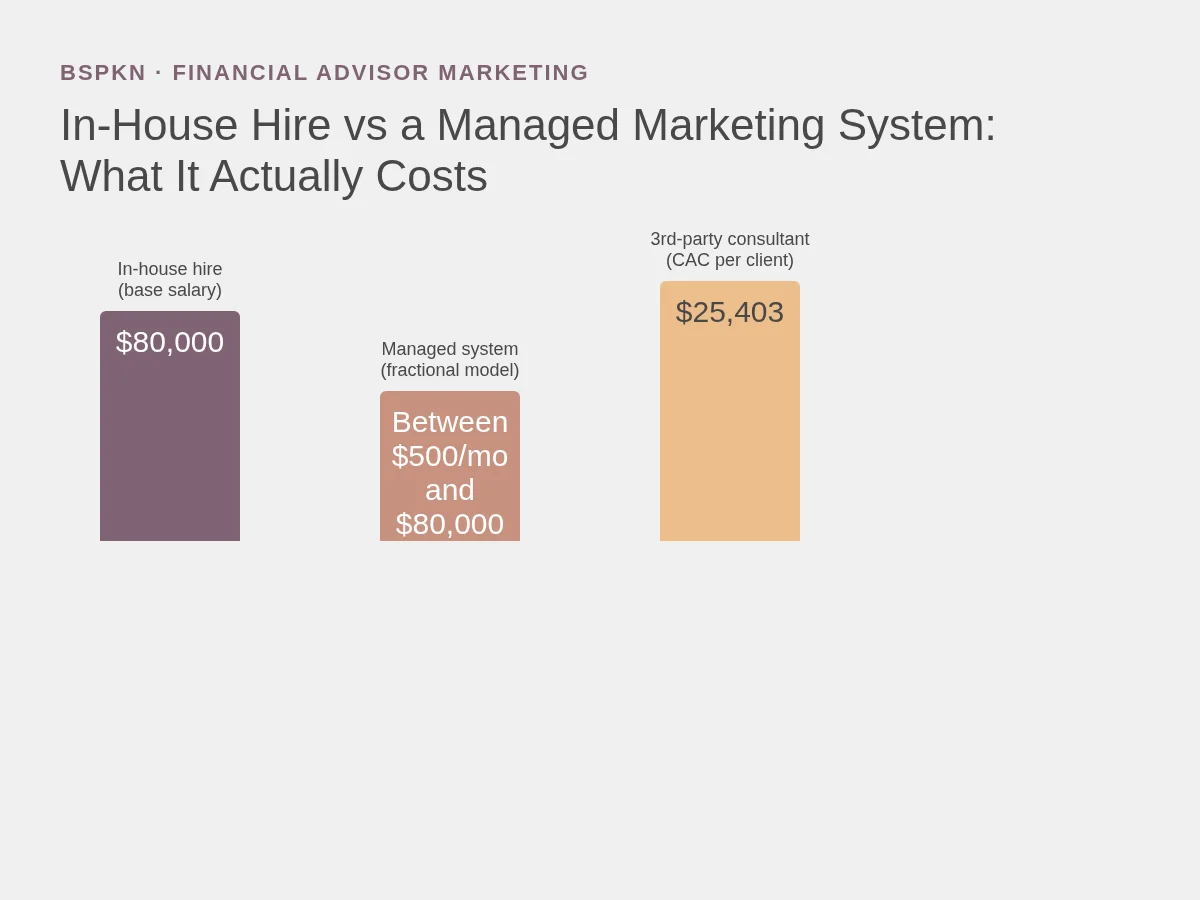
A full-time marketing hire for a Twin Cities RIA or wealth management practice runs toward
$80,000 a year in salary alone before benefits, tools and ad spend, according to
CO Consulting’s financial advisor marketing research (updated Nov 16, 2026). That is the baseline
most advisors compare against when they are deciding how to staff marketing at all, and it is the
wrong baseline to start from, because the real variable is not the headcount line, it is who is
actually running the work day to day. Run a free AI visibility scan
and you can see in minutes whether your firm even shows up when a prospect asks an AI assistant
for an advisor in Minneapolis or St. Paul, which is the question this decision is really about.
Michael Kitces’ 2024 marketing survey put the median registered investment advisor’s client
acquisition cost at roughly $3,800, but that number hides a wide spread by channel: online advisor
directories run about $634 per acquired client, paid advertising runs close to the $3,800 median,
and third-party marketing consultants run the highest, around $25,403 per acquired client. The
in-house-versus-outsourced decision is not abstract. It is the difference between a $634 channel
and a $25,403 channel, and most Twin Cities firms do not know which one they are actually buying.
What a Twin Cities advisory firm is really choosing between
Three structures show up in almost every RIA’s marketing budget conversation. None of them is
automatically right, and the Bureau of Labor Statistics and CO Consulting data below gives a
Minneapolis-St. Paul-Bloomington firm a real floor to compare against instead of a guess.
| Structure | Typical annual cost | What you actually get |
|---|---|---|
| Full-time in-house hire | ~$80,000 base (CO Consulting, Nov 2026) plus benefits and tools | One person, one skill set, full-time overhead whether work is flowing or not |
| Fractional CMO / managed marketing system | Falls between a $500/month tool and an $80,000 in-house hire (CO Consulting) | Senior strategy plus a built system, no benefits, no vacancy risk |
| Third-party marketing consultant, project basis | ~$25,403 average cost per acquired client (Kitces 2024) | Highest cost per client of any channel measured, often the slowest to show up in AI search |
A single in-house marketing hire also means a single point of failure. If that person is on
leave, leaves the firm, or simply does not have a compliance, SEO and AI-search skill set all at
once, the content calendar stalls and so does everything downstream of it, including whether
ChatGPT, Gemini or Google’s AI Overview can find your firm at all when someone in Edina or
Wayzata asks for a fee-only advisor.
The operator argument: a system does not call in sick
This is the part most advisors skip past. Ryan Rivard ran BSPKN with a team of twelve people
doing the work by hand. Most of that department now runs on systems instead, not because the
work got smaller but because the work that used to need a person for every task now runs on a
process that does not depend on any one person showing up. That is the actual tradeoff an advisor
is making: hire one person and hope they can do all of it, or buy a system that was already built
to do all of it, every week, on a schedule, whether anyone is on vacation or not.
For a Twin Cities RIA under $250 million in AUM, CO Consulting’s research puts typical
hard-dollar marketing spend as high as 13.4 percent of revenue at the smallest firm sizes, dropping
to around 7 to 10 percent as a firm scales past $500,000 and then $1 million in revenue. A single
$80,000 hire can eat that entire budget at a smaller firm before a single dollar reaches a tool,
an ad or a piece of content, which is the opposite of what the money is supposed to buy.
Why AI visibility changes the math again
None of this spend matters if a prospect never sees the firm’s name. Referrals still drive
roughly two-thirds of new advisory clients, but the research moment before that referral call
increasingly runs through an AI assistant, and SEO-built, AI-citable content carries the lowest
cost per acquired client of any channel measured, because a well-built page keeps generating
inbound inquiries for years after it is published, unlike a single hire’s bandwidth or a
consultant’s invoice. A Minneapolis or St. Paul advisory firm deciding how to staff marketing
should be asking which option gets them cited by an AI assistant answering “who is a good
financial advisor near me,” not which option fills a job description.
The fastest way to see where your firm stands today is the free scan: run a Peek AI visibility scan
and you get a report on exactly how your firm shows up (or does not) across the AI assistants
prospects are already using before they ever call for a referral.
FAQ
How much does a full-time marketing hire cost a financial advisory firm?
CO Consulting’s financial advisor marketing research (updated Nov 16, 2026) puts a full-time
in-house marketing hire at roughly $80,000 in base salary before benefits, software and ad spend,
which for many Twin Cities firms under $1 million in revenue is most of the entire annual
marketing budget in one line item.
What is a typical client acquisition cost for a financial advisor?
Kitces’ 2024 marketing survey put the median RIA client acquisition cost at about $3,800, with
online advisor directories running the lowest at roughly $634 per client and third-party marketing
consultants running the highest at roughly $25,403 per client.
Is a fractional CMO cheaper than hiring in-house?
CO Consulting frames a fractional CMO or managed marketing system as sitting between a
$500-a-month marketing tool and an $80,000 full-time hire, with senior strategy included and no
single point of failure if one person is unavailable.
What percentage of revenue should a Twin Cities advisory firm spend on marketing?
Benchmarks from CO Consulting put smaller firms (roughly $250,000 to $500,000 in revenue) as
high as 13.4 percent of revenue, with that share dropping to roughly 7 to 10 percent as a firm
scales past $500,000 and then $1 million.
Does AI search change how a financial advisor should market?
Yes. Referrals still drive about two-thirds of new advisory clients, but the research step
before that referral increasingly runs through an AI assistant, so a firm’s AI visibility, not
just its referral network, now affects whether a prospect ever makes the call. A free scan at
peek.bspkn.co shows exactly where a firm stands today.
Want the fuller picture on how AI search is reshaping advisor marketing generally? See our
GEO marketing guide and our
financial advisor marketing page for how
BSPKN builds this as a system rather than a headcount line. If you want a 15 minute walkthrough of
what a managed system looks like for your firm, book a short call.


