

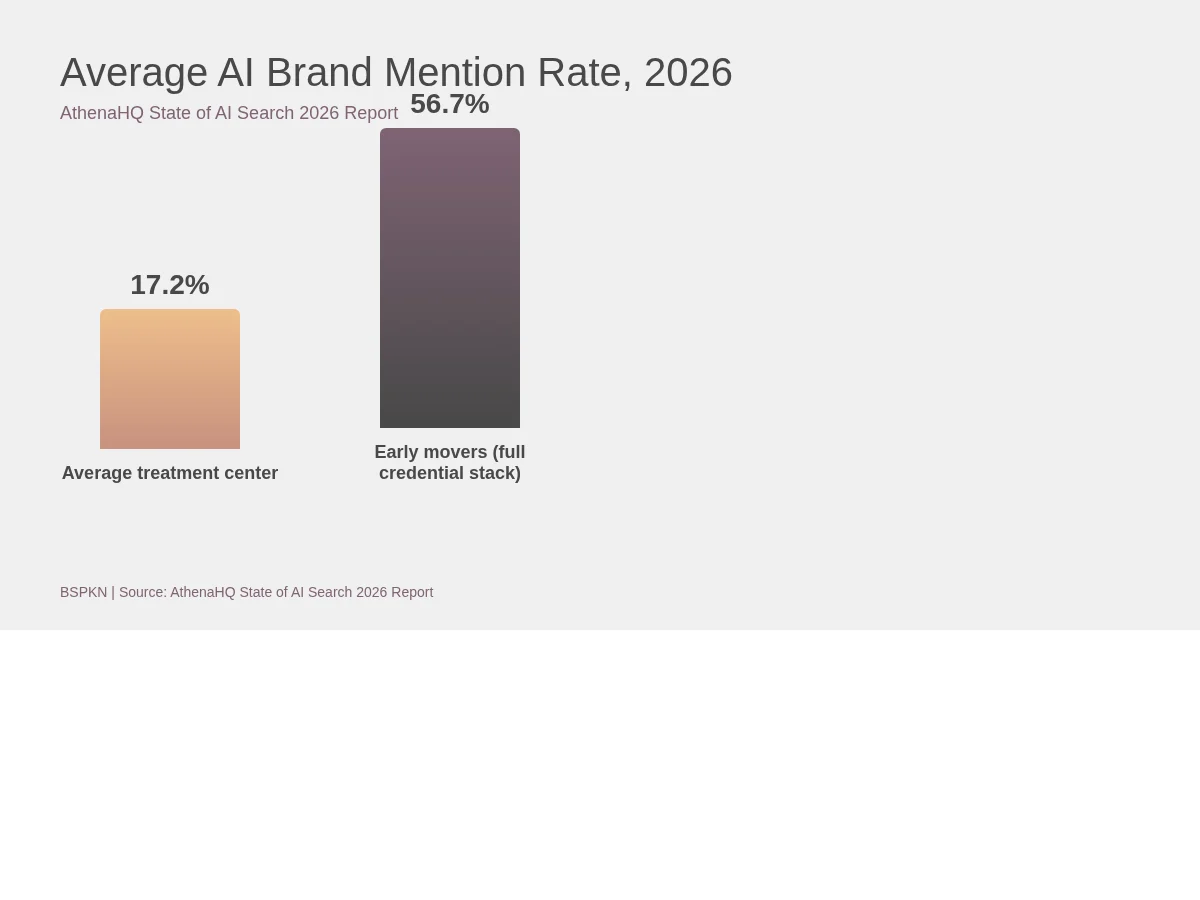
Run this experiment yourself: ask ChatGPT “is [treatment center name] a legitimate rehab” for any facility that does not carry LegitScript, Joint Commission, CARF or SAMHSA recognition in its visible text. In a 14-week analysis of healthcare citations across ChatGPT, Google AI Mode and Google AI Overviews (October 2025 to January 2026), BrightEdge found ChatGPT pulls 27 percent of its healthcare citations from government sources and Google AI Overviews pulls 33 percent from elite hospital systems, 10 percent from government sources. Neither platform leans on uncertified directory listings or uncited blog content to answer the question. A separate 2026 State of AI Search report from AthenaHQ found the average AI answer mentions any single brand only 17.2 percent of the time; the facilities AthenaHQ classifies as “early movers” are mentioned 56.7 percent of the time, roughly 3x the category average.
Not every credential does equal work. Treatment centers in the Twin Cities, Nashville, Phoenix and every other metro are paying for the same five-logo stack (LegitScript, Joint Commission, CARF, ASAM, SAMHSA) without knowing which of the five actually changes whether ChatGPT, Perplexity or Claude will say their name.
What each AI engine actually weighs
The four major engines do not select sources the same way. Behavioral health content is treated as Your Money or Your Life (YMYL) content by every one of them, which raises the bar on authorship and evidence sourcing well above a typical local business query.
| Engine | Sources per answer | What it weights for behavioral health |
|---|---|---|
| ChatGPT (OpenAI) | 2 to 4 | Government sources (27% of healthcare citations) plus high-authority editorial and Wikipedia inclusion |
| Google AI Overviews | Multiple, often 5 to 10 | Elite hospital systems (33%) and government sources (10%); still pulls 78% from the top 10 organic results first |
| Perplexity | 4 to 8 | Forum and evidence-backed material; rewards source transparency directly |
| Claude (Anthropic) | Few, authority-weighted | Named clinical authors (MD, LCSW, LMFT, PhD) and government health agency references; the strictest YMYL screen of the four |
LegitScript does not move rankings, but it moves citations
Google has never confirmed LegitScript certification as a ranking factor, and nothing in Google’s own search documentation references it. That leads some operators to treat the fee as sunk cost. The 2026 data says otherwise for AI citation specifically: LegitScript, JCAHO or CARF accreditation, ASAM recognition and SAMHSA federal recognition are the five credential types that map cleanly to what AI engines call a “recognized industry organization,” and centers carrying all five, structured into visible page text and schema markup rather than buried in a footer logo strip, are the ones showing up in the 56.7 percent early-mover bracket instead of the 17.2 percent average.
The distinction that trips up most marketing teams: a credential logo in a footer carousel is not the same signal as a credential named in a sentence an AI engine can retrieve and quote. A page that says “accredited by the Joint Commission and certified by LegitScript” in visible body text, with the matching schema markup behind it, is citable. A badge graphic with no alt text and no surrounding sentence is not.
Named clinical authorship is no longer optional
Every factual claim on a behavioral health page now needs an external citation to a source like NIDA, SAMHSA or a peer-reviewed study for an AI engine to treat it as reliable. Pages without a named clinician as author, or with “admin” as the byline, are structurally disadvantaged in the selection process for Claude and increasingly for ChatGPT. Promotional language such as “compassionate care” or “healing environment” is recognized and down-weighted for informational queries; AI engines are tuned to prefer content that reads like a clinical reference with operator perspective layered on, not a brochure.
What to check this week
| Checklist item | Why it matters for citation |
|---|---|
| LegitScript, JCAHO/CARF, ASAM and SAMHSA named in visible body text, not just logos | Maps to the “recognized industry organization” signal AI engines weight for YMYL healthcare queries |
| Named clinical author (MD, LCSW, LMFT, PhD) with a live profile page on every clinical page | Required for Claude’s authority-weighted selection, increasingly weighted by ChatGPT |
| Every clinical claim linked to NIDA, SAMHSA, CDC or a peer-reviewed source | Unsourced assertions get excluded or down-weighted across all four engines |
| Credential and author data structured in schema markup, not just page copy | Gives engines a machine-readable version of the same trust signal |
Frequently asked questions
Does LegitScript certification help SEO rankings?
Not directly. Google has not confirmed it as a ranking factor and internal comparisons of certified versus uncertified behavioral health sites show no clean ranking lift from the certification alone. Its measurable 2026 value is in AI citation eligibility, not classic rankings.
Which AI engine is strictest about credentials?
Claude. It returns the fewest sources per answer and weights named clinical authorship and government health agency references more heavily than ChatGPT, Perplexity or Google AI Overviews.
How much of a difference does this actually make?
AthenaHQ’s 2026 data puts the average brand mention rate at 17.2 percent of AI answers, with early movers (the operators with a full, visible trust-signal stack) at 56.7 percent, about 3x the average.
Is a footer logo of our accreditations enough?
No. AI engines retrieve and quote sentences, not image files. The credential has to appear in readable text near the claim it supports, ideally backed by matching schema markup.
Does this apply outside addiction treatment?
The YMYL scrutiny and credential weighting apply across behavioral health broadly, including outpatient mental health and dual diagnosis programs, anywhere an AI engine treats the query as a health and safety decision.
Most of this is invisible until someone checks. The free Peek AI visibility scan runs your actual name through ChatGPT, Perplexity and Google AI Mode and shows exactly which of your credentials are being read and which are being skipped, no cost, no sales call required to see the report.
For a deeper look at how AI engines select and weight sources across every vertical, see our GEO marketing practice, and for the behavioral health-specific playbook see healthcare marketing. Related reading: Schema Markup and AI Citations for Treatment Centers and Is Your Treatment Center’s Website Readable by AI?.
If you want someone to walk through your scan results and what to fix first, book a free 15-minute strategy call.


